
Credit cards & debt consolidation
What Happens If I Miss a Credit Card Payment in Canada?
A practical guide to catching up, comparing your options and finding a manageable way forward.
The short answer
Missing a credit card payment can increase your borrowing costs and affect your credit. Contact your card issuer promptly. If several payments no longer fit your budget, debt consolidation may help—but only if the new repayment plan is affordable.
A missed due date can feel overwhelming. It may be a one-time oversight, an unexpected expense or a sign that your monthly payments have become too much. One missed payment does not define your financial future. Your next step is to work out which situation you are facing.
If you are looking for debt consolidation in Edmonton, this guide explains what happens after a missed credit card payment, how to assess a consolidation offer, and what to consider when another loan will not solve the problem.
What are the consequences of a missed payment?
If your minimum payment is late or unpaid, you could face a higher interest rate, lose a promotional rate, damage your credit or have your card cancelled. Your agreement determines the consequences. The Financial Consumer Agency of Canada explains these late-payment risks.
Paying the minimum and paying the full statement balance do different jobs. The minimum keeps you meeting that payment obligation; it does not usually prevent interest on a balance you carry. Check your statement for both amounts and the due date.
Will one late payment hurt your credit score?
It can. The effect depends on the information reported and your overall credit history. Do not assume you have a guaranteed 30-day window with no consequences. Ask the issuer about your account status, what it reports and what payment is needed to bring the account current.
What if you remain behind for several months?
Your creditor may pursue collection or refer the account to a collection agency. There is no universal date when every account moves to collections. Legal action may also be possible; an unpaid card balance does not automatically mean a lawsuit.
Edmonton residents can consult Alberta's rules for creditors, collection agencies and debt repayment to understand permitted collection practices. Keep statements, letters and records of conversations. If you receive court documents, seek advice promptly rather than leaving them unanswered.
What to do after a missed payment
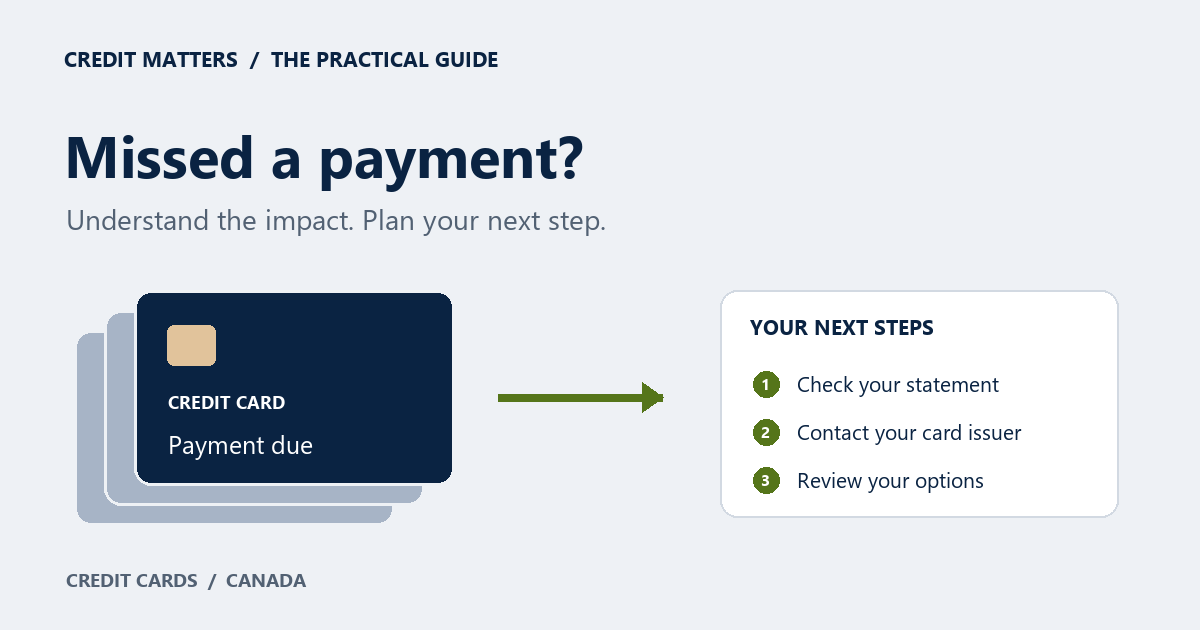
- Check the exact amount owing. Open the latest statement and confirm the overdue amount, minimum payment and next due date. Check whether a payment is still processing.
- Contact your card issuer. Explain what happened. Ask what would bring the account current and whether a payment arrangement or hardship option is available. Get any agreement in writing.
- Pay what you can responsibly afford. If you can catch up, arrange the payment promptly. If you cannot, discuss that honestly with the issuer; a payment below the required minimum may still leave the account overdue.
- Review your next month of bills. Include housing, food, utilities, transport and every debt payment. This tells you whether the problem was a missed reminder or a recurring shortfall.
- Make the next due date visible. Use reminders or automatic payments when your account has sufficient funds. Check your credit reports with Equifax and TransUnion and raise any reporting errors.
Before you borrow to cover a payment, write down how you will repay that new borrowing. Moving a bill to another credit card or a payday loan can leave next month's budget under even more pressure.
What if I cannot afford the minimum payment?
Tell your card issuer before the next due date if possible. Explain what you can pay and when, and ask how any proposed arrangement affects interest, account status and credit reporting. Do not promise an amount your budget cannot support.
Then look beyond that one card. Write every payment on the same calendar alongside your pay dates. If the shortfall keeps returning, you need a plan for your total debt. A smaller payment on one account may offer temporary breathing room, but it will not resolve a budget that falls short every month.
Can credit card debt consolidation in Edmonton help?
Debt consolidation combines debts into one payment. With a consolidation loan, you borrow to repay existing balances, then repay the new loan. It simplifies the payment schedule; it does not erase the amount you owe.
A lower rate may save money, but a longer repayment term can increase the total cost. Your credit history also affects the rate you may qualify for. Compare the whole offer, not just its monthly payment. See the FCAC guide to debt consolidation.
Start with your monthly breathing room
Subtract essential expenses and other commitments from reliable take-home income. Leave room for irregular costs, such as car repairs. The amount remaining is the starting point for assessing a proposed payment—not the amount a lender says you can borrow.
Questions to ask before accepting a consolidation loan
- What are the interest rate, fees and total amount repayable?
- Is the rate fixed or variable, and when will the debt be fully repaid?
- Does the payment fit a lower-income month as well as a typical month?
- Is the loan secured against an asset, and what happens if payments are missed?
- How will I avoid building new balances on the cards I pay off?
For example, imagine a proposed loan payment is $450, but your written budget leaves only $300 after essentials and other commitments. Combining the bills has not closed that $150 gap. You need to revisit the plan before signing.
You can explore the process on our debt consolidation service page or discuss your budget through financial counselling.
Compare consolidation with other debt relief options
Several approaches may involve one payment, but they are not interchangeable. Ask exactly which arrangement is being proposed, who administers it and how it affects your credit.
| Option | How it works | Key consideration |
|---|---|---|
| Consolidation loan | A new loan pays existing balances. | Approval and pricing depend on the lender. Compare the full cost and your ability to repay. |
| Debt management plan | A credit counsellor proposes a repayment arrangement to creditors. | You generally repay the principal. Interest relief depends on creditors agreeing; fees may apply. |
| Consumer proposal | A Licensed Insolvency Trustee administers a formal offer to creditors. | It may reduce what you repay or extend repayment, up to five years. Eligibility and credit consequences need assessment. |
A debt management plan is an informal arrangement, and creditors may decline it. It does not provide the same legal protection from collection as a formal insolvency process. Read the FCAC explanation of credit counselling and debt management plans.
A consumer proposal is a legal process, not a consolidation loan. Only a Licensed Insolvency Trustee can administer it. You can contact a trustee directly to assess this option and discuss bankruptcy where appropriate. The Office of the Superintendent of Bankruptcy explains consumer proposals.
When to seek credit card debt help in Edmonton
Look at the overall pattern. Are you repeatedly borrowing for groceries, missing one payment to make another, or seeing little progress despite paying every month? Those are useful signals to review your finances before applying for more credit.
Bring a list of balances, interest rates, minimum payments, income and essential expenses to a consultation. Include any collection letters. You do not need a perfect spreadsheet: recent statements and a realistic picture of your month are a practical start.
Credit Matters helps you look at the whole situation and understand possible next steps. Ask about the cost of any recommended service, who provides it and what alternatives are available before committing.
Common questions
What if my credit card payment is only one day late?
Check whether the payment has reached your account, then contact your issuer if you are behind. Even a short delay can have consequences under your card agreement. Do not wait for a particular number of days before catching up or asking for help.
Can I get debt consolidation in Edmonton with bad credit?
Possibly, but approval is not guaranteed and the offered rate may make borrowing more expensive. Compare the full cost. If the payment does not fit your budget, discuss repayment options before taking another loan.
Does debt consolidation reduce the amount I owe?
A consolidation loan pays off debts using new borrowing. You still repay that loan. Interest savings are different from reducing the principal through a formal arrangement such as an accepted consumer proposal.
Should I stop paying my credit cards while looking for help?
Do not assume that asking for help pauses your payment obligations. Contact your issuers about payments you cannot make. If you are considering a formal insolvency process, ask a Licensed Insolvency Trustee how payments should be handled.
Will speaking to a credit counsellor affect my credit score?
Simply speaking with a credit counsellor does not affect your score, according to FCAC. Applying for new credit or entering a repayment or insolvency arrangement can have different effects. Ask about the specific option before proceeding.
Sources and editorial note
This guide uses the FCAC, Government of Alberta and Office of the Superintendent of Bankruptcy resources linked above. Information checked September 16, 2026.
Prepared for Credit Matters. General information only; the right approach depends on your circumstances. Card agreements, lender decisions and program requirements vary. Consumer proposals and bankruptcies require a Licensed Insolvency Trustee.
Your next step
You do not have to figure it out alone.
Talk to Credit Matters about credit card debt help in Edmonton. Start with a confidential, no-obligation consultation.